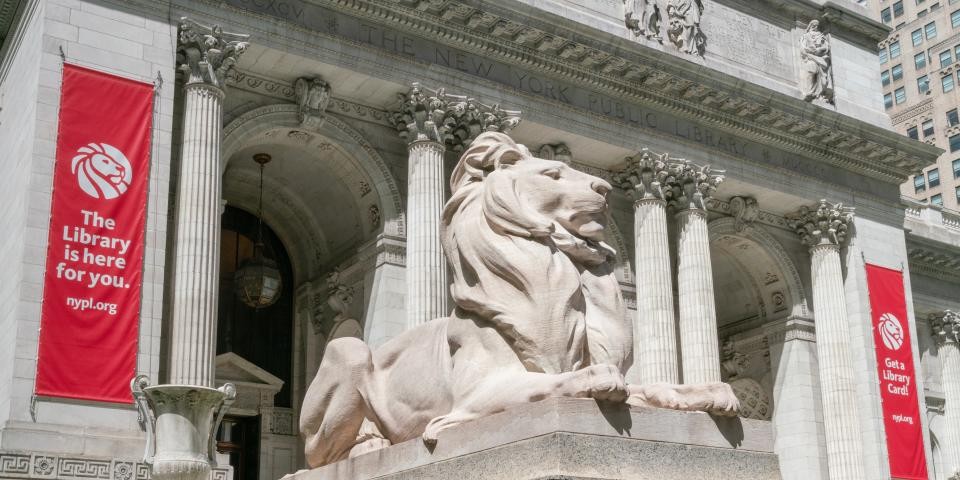


A how-to guide for researching New York City buildings & architecture featuring books and digital resources available at the Mid-Manhattan Library.

Need help? Consult an Art Librarian at the Mid-Manhattan Library or at the Humanities and Social Sciences Research Library at 42nd and 5th Avenue. The Mid-Manhattan Art Collection is at 455 Fifth Avenue, 3rd Floor (between 39th and 40th Streets), New York, NY 10016. (212) 340-0871.


Basic questions can usually be answered with the help of a reference book on architecture. These books are located in the Art Closed Shelf Reference section, in the Art stacks under call numbers 720.9747 and 917.471, elsewhere at Mid-Manhattan (such as General Reference on the 2nd floor and History on the 5th floor) and at other branches. Search the LEO catalog to see NYPL holdings for these titles.

Recent Guidebooks: Basic Information such as year of construction, architect and architectural style for architecturally notable buildings

Reference Books

Historical Guidebooks

Landmark buildings and districts: If you happen to be researching a landmark building or district, you’re in luck.

New York in 5 volumes: Robert A. M. Stern offers an in-depth look at the buildings, neighborhoods and transportation that defined five eras of New York history

Just the facts ma’am

Architects: find out more about your guy or gal

Where Do You (Wish You) Live?: homes that characterize New York

Didn’t this used to be…?: buildings that no longer exist

Fancy Schmancy

I need a new place to eat my lunch

Turn-of-the-century photographs


RESEARCH GUIDES

Here are five excellent guides to researching New York City architecture. Each one has a different emphasis. Read the descriptions to determine which one is right for you.

  1. How to Research a New York City Building
    Avery Architectural & Fine Arts Library, Columbia University Libraries
    A thorough list of print, electronic and other resources for researching New York City architecture.
  2. Hints on Researching New York City Buildings [MS Word]
    Word document by Andrew S. Dolkart on Avery’s online research guide.
    Detailed instructions on how to navigate New York City’s Byzantine city agencies with information on opening hours, procedures and fees, and an overview of resources available at Columbia University Libraries, NYPL and other institutions.
  3. A Guide to Research Resources in New York City
    NYC Landmarks Preservation Commission
    Basic research tips and a comprehensive list of agencies and resources in all five boroughs. Includes contact information, holdings, services and procedures.
  4. A Guide To Researching the History of a New York City Building
    New York Society Library
    How to spend a day doing research at city agencies – focuses on the social history of a building. Adapted from a July 2, 1995 New York Times article by NYC architectural guru Christopher Gray. A slightly updated version was published in the Times on December 5, 2004.
  5. Investigating New York City Architecture: How to research a building
    Vincenzio Rutigliano, Art and Architecture Collection of The New York Public Library Humanities and Social Sciences Library
    Inquire at Room 300, at the Wallach Art and Architecture Division at the Humanities and Social Sciences Research Library. A bibliography of books and other resources available at the NYPL Humanities and Social Sciences Research Library, including their call numbers, and a list of institutions for architectural research.

NYC GOVERNMENT RESOURCES

New York City has several government agencies that deal with buildings.

1. Landmarks Preservation Commission (LPC)

The Landmarks Preservation Commission is responsible for identifying, designating and regulating the city's landmarks and the buildings in the city's historic districts. The Commission, which consists of eleven Commissioners and a full-time staff, was established in 1965. The Landmarks Law was enacted in response to New Yorkers' growing concern that important physical elements of the city's history were being lost despite the fact that these buildings could be reused. Events like the demolition of the architecturally distinguished Pennsylvania Station in 1963 increased public awareness of the need to protect the city's architectural, historical, and cultural heritage.

Designation Reports are published by the Commission and are extensive sources of information. Contents may include description of building, building history, construction details, architect backgrounds, drawings, plans and photographs. Recent reports are available from LPC’s website. Older reports are in print format and can be purchased from LPC. Mid-Manhattan Library has a few reports. Check the LEO catalog for holdings. The Humanities and Social Sciences Library is ordering the complete set. Check CATNYP for holdings.

All Historic District Maps are online. The designation process is interesting and is described in the introductory essay in Barbaralee Diamonstein-Spielvogel’s book The Landmarks of New York.

2. Department of Buildings (DOB)

The NYC Department of Buildings ensures the safe and lawful use of over 900,000 buildings and properties by enforcing the City's Building Code, Electrical Code, Zoning Resolution, New York State Labor Law and New York State Multiple Dwelling Law. Its main activities include performing plan examinations, issuing construction permits, inspecting properties, and licensing trades. It also issues Certificates of Occupancy and Place of Assembly permits.

Building owners must submit applications to DOB before commencing work on properties. These filings, which go back to 1866 for Manhattan and the 1870s for other boroughs, are called Actions and include: New Building (NB), Alteration (ALT), Building Notice (BN), Demolition (DP) and Certificate of Occupancy (CO). The most useful form is the NB, which describes building specifications, materials, and classification, date of construction; owner and architect; and cost.

To find a list of actions for an address or block and lot, use DOB’s online database, Buildings Information System (BIS).

  1. Go to http://a810-bisweb.nyc.gov/bisweb/bispi00.jsp
  2. Under “Search by Property”, enter (1) the borough and address or (2) borough and block and lot numbers. (The database accepts the addresses entered in a variety of formats: “455 Fifth Avenue” and “455 5th Ave.” are both acceptable.)
  3. This will take you to the “Property Profile Overview,” which features the block and lot number for that property as well as other basic information. Note that there may be multiple buildings on the lot.
  4. Scroll to the bottom of the page and click on “Actions”.
  5. Browse through the actions until you get to the NB. The number after the hyphen tells you the year the application was filed (an asterisk indicates the year is before 1900), and the first number tells you the chronological order of that application in that year.

To see the records for a specific block and lot, go to the appropriate DOB borough office. Records are in microfilm, Individual Property Folders (which contain new building and other applications and architectural drawings and plans) and Rolled Plans (the architectural plans, elevations, or engineering drawings that are too large to be kept in the folders). See the LPC guide and Andrew Dolkart’s guide for details.

If you only need basic information such as the architect, owner, cost of construction and description of the building, you can use Christopher Gray’s Office of Metropolitan History New Building Permits Database, 1900-1986.

  1. Go to http://www.metrohistory.com/searchfront.htm
  2. Enter two fields: the Year (the number after the NB hyphen) and DOB NB# (the number before the hyphen) to directly access a record.
    OR
  3. Search within other fields such as Cost, Building Address, Owner, Owner Address, Architect, Architect Address, Description and Comments. There are search tips on the webpage. Note that searching by address can be tricky because of the various ways it can be stated.
  4. You will be presented with a list of search results.

3. Municipal Archives (New York City Dept. of Records and Information Services)

Founded in 1950, the Municipal Archives preserves and makes available the historical records of New York City municipal government. Dating from the early seventeenth century to the present, the Municipal Archives holdings total approximately 160,000 cubic feet. Accessioned from more than one hundred city agencies, the collections comprise office records, manuscript material, still and moving images, ledger volumes, vital records, maps, blueprints, and sound recordings.

4. Department of City Planning (DCP)

The Department of City Planning is responsible for the city's physical and socioeconomic planning, including land use and environmental review; preparation of plans and policies; and provision of technical assistance and planning information to government agencies, public officials, and community boards.

5. Department of Housing, Preservation & Development (HPD)

The New York City Department of Housing Preservation and Development (HPD) is the largest municipal developer of affordable housing in the nation.

6. Art Commission

The Art Commission is NYC's design review agency. Established in 1898, the Commission reviews permanent works of art, architecture and landscape architecture proposed for City-owned property. Projects include construction, renovation or restoration of buildings, such as museums and libraries; creation or rehabilitation of parks and playgrounds; installation of lighting and other streetscape elements; and design, installation and conservation of artwork. The Commission is composed of 11 members, and includes an architect, landscape architect, painter and sculptor as well as representatives of the Brooklyn Museum, the Met and NYPL. The Commission holds monthly public hearings in its offices on the third floor of City Hall, where it has resided since 1914. The Commission also acts as caretaker and curator of the City's public art collection and maintains an extensive archive documenting the history of New York City's public works

7. Department of Design and Construction (DDC)

The Department of Design and Construction, created in 1995, builds the sewers, water mains, roads, and public buildings in New York City.


BOOKS, ARTICLES and PICTURES

The Mid-Manhattan Art Collection has a strong collection of architecture books, many of which you can take home.

Architects’ monographs show plans, drawings, criticism and architects’ writings, and are mostly filed under call number 720.92. Important buildings sometimes have an entire book dedicated to them and are classified according to the building type (school, religious building, train station, etc.) Search LEO for the name of the architect or the name of the building to find the appropriate call number.

For general books on New York City architecture, browse the books in call numbers 720.9747 and 917.471.

Dover Publications publishes many books on New York architecture and interiors. Search LEO using the keywords Dover + New York + Architecture or Dover + New York + Interiors to find these books.


Articles

You can get professional quality articles from the following article databases to which the Library subscribes. These databases are only accessible from the Library, although you can get information about our databases here. Some of these databases give you the full text (entire) article, which you can print out. Some of them only give you an abstract (summary) and the date, title, source (publication) and page number of relevant articles, and you would seek out the publications at the Mid-Manhattan Library 4th floor or Room 108 at the Humanities and Social Sciences Research Library to read and copy the article.


Pictures

The Mid-Manhattan Library’s Picture Collection has thousands of high quality pictures, arranged by subject, that you can bring home. There are folders for:

A description of the collection and a list of subject headings are online.


PICTURES ONLINE

This section outlines 3 free websites for digital architectural images.

1. NYPL Digital Gallery

The New York Public Library has scanned thousands of historical books and photographs in its collections, and made them available in a free database called The Digital Gallery. You can browse through the images by Collection or subject, or you can search the database for keywords. For the purposes of architectural research, you can browse the Collections in this list, or you can do a keyword search for a specific building or address. Each collection was catalogued a little bit differently, so try different spellings and abbreviations if nothing comes up.

2. Library of Congress

The American Memory online collections by The Library of Congress is another historical image database. You can search the database or browse by topic such as “Architecture, Landscape” and “Cities, Towns”. Excellent collections include “Architecture and Interior Design for 20th Century America: Photographs by Samuel Gottscho and William Schleisner, 1935-1955.”

3. PropertyShark

This website, primarily for real estate professionals, features an overview, photos, toxic sites, maps, phone records, neighbors, property tax, zoning and building class, floor area ratio and air rights, building permits, ECB violations, income & expense, demographics and judgements & liens for properties in the five boroughs and in other cities.

PropertyShark also has maps showing all sorts of interesting information such as building classes, air rights, liquor license prohibited regions, subway ridership, single men availability (!) and years built.


SAMPLE QUESTIONS

Here are some sample questions with some suggested sources for research. The best sources will vary according to the building you are researching and the specific information you are searching for, but this list should help if you are stumped.

Question Where to Look
1. Who was the architect?
2. When was it built?
3. How much did it cost?
4. What style is the building?

5. What’s it made out of?

6. How was it constructed?
7. How many stories is the building?
8. What is the building used for? What has it been used for?
9. Is it a landmark building? Was it ever considered for landmark status?

10. All about a landmark building?

11. How is an area zoned?
12. Are there any development plans for an area?
13. Has the building ever been altered?
14. What is the block and lot number of a building? What is its size?
15. Have there been changes to the block and lot? How to convert metes and bounds (from Office of Metropolitan History NB database) to a block and lot number?
16. Architect plans or drawings for a building?
17. Historic photographs of the building?

18. Current photograph of the building?

19. Who has lived there?
20. Who has owned it?
21. History of a building?

22. Who owns it now?

23. Resources for Apartment seekers? Homeowners?

24. What libraries are best for researching architecture in New York City?

25. Locations of toxic sites?

26. History of the inhabitants?

27. History of neighborhood?
28. People in New York City history?
29. Architectural criticism?
30. How can I be involved in the shaping of the City?
  • Landmarks Preservation Commission Public Hearings
  • Department of City Planning Public Hearings
31. How much is a building worth?
32. World’s Fairs?

33. New York City architects?

34. Public Space?

35. Where to buy publications on NYC architecture?

36. Photographs of Interiors?
37. Extensive drawings and photographs of Public Works?

38. Opening hours of NYC government research centers?